


Many people assume their families will support them as they age. However, for some people this isn’t realistic for different reasons. So, what happens if you don’t have a trusted person around to make sure your wishes about different aspects of your life are respected?
There are two arrangements available to you that you can put in place to ensure your wishes are carried out. These are called Enduring Power of Attorney (or EPAs) and Enduring Power of Guardianship (EPGs) agreements.
Tammy in the Advocare Advocacy team knows a lot about this topic and is also a qualified Social Worker. She regularly helps older people navigate decisions about their rights, care, and wellbeing.
“Knowing what EPAs and EPGs are and how they can help is important. It’s clearly an area where older people still need information to understand them and the implications of each. Many of the calls to the WA Elder Abuse Helpline are also about these arrangements being misused, and people want to know what to do about that.”
That’s why it’s worth taking time to understand what EPA and EPG documents are, and how they can give you peace of mind, even if you don’t have someone close by to nominate.
What is an Enduring Power of Guardianship?
The Office of the Public Advocate describes an Enduring Power of Guardianship (EPG) as:
“…a legal document that authorises a person of your choice to make important personal, lifestyle and treatment decisions on your behalf, should you ever become incapable of making such decisions yourself.” (OPA, August 2023).
This means that if you lose capacity, the guardian you’ve nominated can step in to guide decisions about your medical care, living arrangements, and lifestyle choices, ensuring that your wishes are still respected.
Without this document, service providers may sometimes turn to a ‘next of kin’ for consent. But next of kin don’t automatically have legal authority to make decisions on your behalf. Having an EPG in place removes uncertainty and sets out clearly who can speak for you, if you can’t.
What about an Enduring Power of Attorney?
An Enduring Power of Attorney (EPA) arrangement is slightly different. While an EPG covers lifestyle and treatment decisions, an EPA deals with property and financial matters.
With an EPA in place, the person you nominate can manage your money, pay bills, or look after your property if you’re no longer able to. Together, an EPA and EPG cover the two major areas of decision-making – financials and personal.
Quick comparison: EPA vs EPG
Here’s a side-by-side look at the two arrangements:
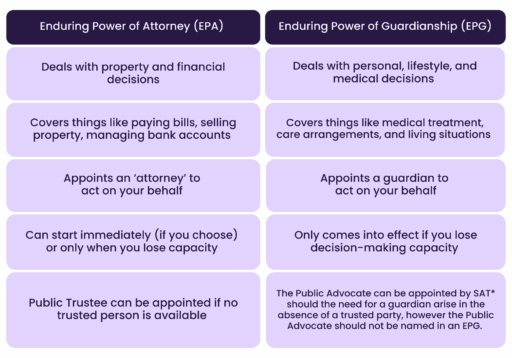
* State Administrative Tribunal
Both arrangements can operate separately or together. Many people choose to have both for full coverage.
What if you don’t have a trusted person in mind?
If family or friends aren’t an option for whatever reason, here are a few things to think about.
Tammy tells us, even if you don’t have close family or friends you feel comfortable nominating, there are options:
- The Public Advocate can sometimes be appointed as a guardian, if the matter goes through the State Administrative Tribunal (SAT).
- The Public Trustee can act as an attorney for financial matters.
- Independent professionals can be appointed in certain circumstances.
“While these options might feel less personal, they ensure there is someone legally responsible for your decisions and wellbeing. Most importantly, they prevent uncertainty or disputes later on,” she adds.
Expectations of a nominated person in EPG or EPA arrangements
If you do nominate someone as your guardian, they need to be prepared for the responsibility. Tammy’s advice is simple:
- Choose carefully. Trust is essential.
- Avoid conflicts of interest. Try to select someone who can act independently.
- Make sure they can communicate effectively. A guardian may need to speak with doctors, service providers, or other professionals.
- Encourage openness. The best guardians keep others updated and involve the right people in decisions when necessary.
- Check the paperwork. Both you and your chosen guardian must sign the document for it to be valid.

Can you cancel these arrangements?
Be aware both arrangements (EPAs and EPGs) aren’t permanent. If you still have decision-making capacity, you can revoke either of them at any time.
Tammy explains, “All you need to do is write a letter stating you’ve revoked the document, attach the original, and provide it to the person you appointed and to any organisations who may hold a copy, such as your GP, aged care provider, banks or other financial institutions. It’s simple, but it helps to keep track of where copies were sent.”
It is also recommended that you collect and destroy copies of the revoked document to avoid later confusion.
Remember, if you’ve lodged your EPA with Landgate, the revocation of your EPA will not take effect until the revocation is also lodged with Landgate. If you’ve lost capacity, however, the process becomes more complex. In those cases, the State Administrative Tribunal may need to review the arrangement, which can be stressful and time-consuming. Planning ahead reduces the chance of this happening.
Also, in the case of EPAs, attorneys need to be aware that some organisations expect to see the original, signed EPA if you need to take action on the older person’s behalf, not a copy. Check ahead first to avoid frustration.
Why future planning matters
Thinking about the future isn’t always easy, but it’s one of the most important steps you can take to make sure your preferences are respected.
Having an EPA and EPG in place gives clarity to service providers, avoids unnecessary delays, and ensures your financial, health, and lifestyle choices are carried out the way you want them to be.
So even if you don’t have a trusted person around, there are still safe, supported options available to protect your rights and guide your future.
If you have concerns about your current arrangements, contact Advocare on the Aged Care Advocacy Line on 1800 700 600.
For more information about Enduring Power of Guardianship (EPGs), contact the Office of the Public Advocate on 1300 858 455 or visit:
Office of the Public Advocate WA – Enduring Power of Guardianship.
Enduring Power of Attorney Information Kit
Enduring Power of Guardianship